
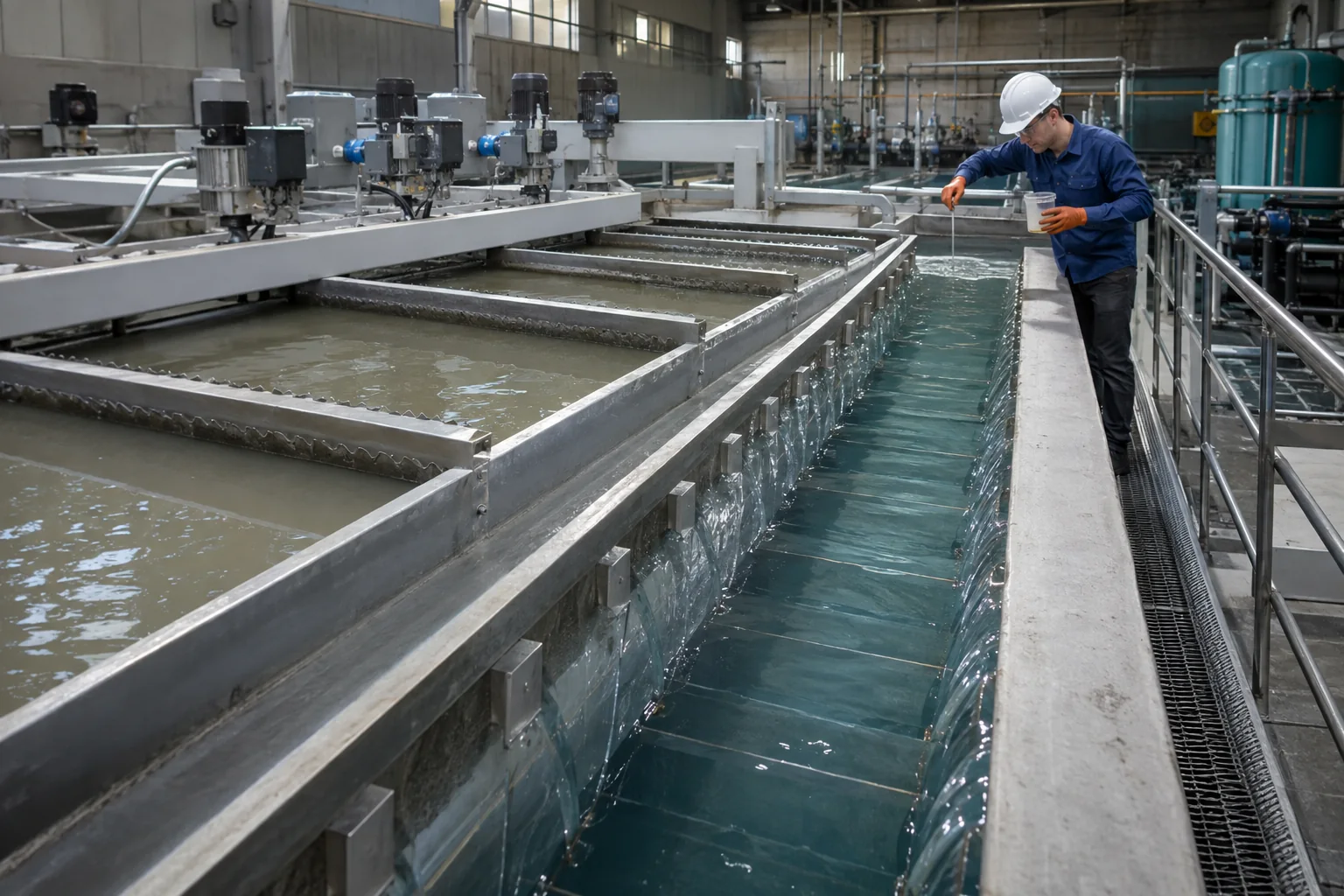
Industrial clarification often forms metal-hydroxide or precipitated microfloc with PAC, alum, ferric or pH adjustment before anionic polyacrylamide is added for bridging. Polymer cannot compensate for an unstable precipitation or coagulation step.
Establish the chemistry baseline
Record wastewater source, batch or production state, pH, temperature, conductivity, turbidity or suspended solids and the target parameter. For metals or phosphorus, distinguish dissolved and total results when the decision requires it.
Run untreated and coagulant-only controls. Fix pH, coagulant dose, rapid mix and formation time before comparing APAM products.
Place polymer after microfloc formation
Distribute dilute polymer quickly enough to contact the suspension, then reduce energy for floc growth. Excessive rapid mix after bridging creates fragments; inadequate distribution leaves untreated zones and local overdose.
Measure settling time, supernatant quality, sludge volume and downstream dewatering. Visual clarity alone is insufficient when discharge or reuse specifications control the process.
Scale one variable at a time
Confirm chemical strength, pump calibration, addition points, residence and clarifier hydraulics. Hold coagulant and mechanical settings stable during the first plant polymer comparison, then optimize the combined program in controlled steps.
Document active dose and as-supplied consumption separately for a fair commercial comparison.