
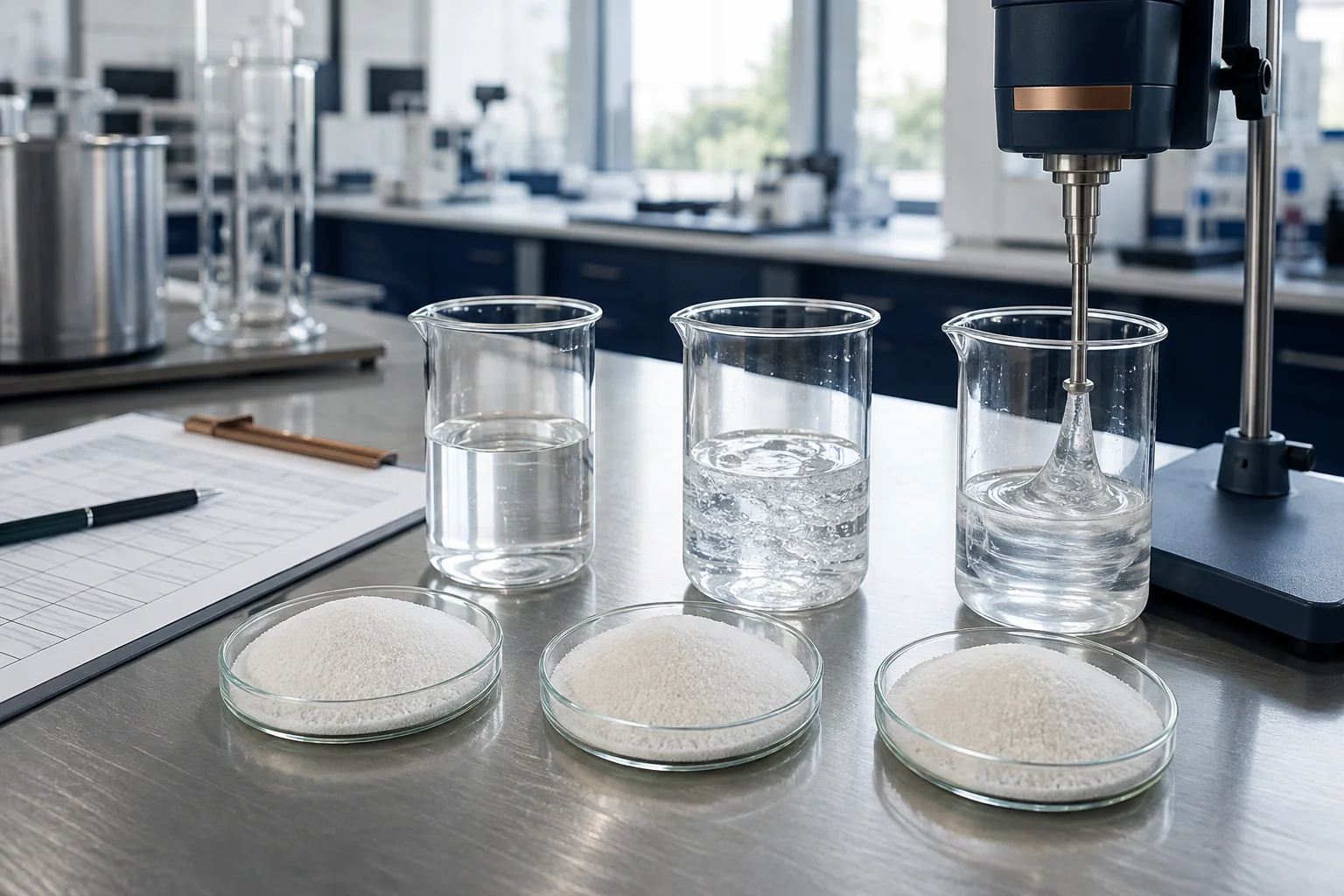
Anionic polyacrylamide is a family of water-soluble, negatively charged polymers. A commercial grade is defined by more than the letters APAM: molecular size, anionic character, architecture, active content, particle form and solution behavior all influence the plant result.
Read the specification as a trial map
High molecular size can extend bridging reach, while anionic character affects interaction with the solids and dissolved ions. Neither value should be treated as a quality score. A grade that creates very large floc can still give poor compaction, fragile floc or difficult filtration.
Use the three profiles below to organize samples. They are selection directions rather than universal recipes. Final approval belongs to a controlled comparison on representative feed using the actual separator endpoint.
Describe the feed before naming a grade
Provide solids concentration, particle-size distribution, mineral or precipitate type, pH, conductivity, hardness and any coagulant, dispersant or process reagent. Identify whether the objective is clear overflow, higher solids flux, denser underflow, cleaner filtrate or shorter filtration cycle.
A product selected only from industry name can miss changes caused by clay fraction, recycle salts or upstream chemistry. Include normal and difficult feed conditions when the process varies.
Compare candidates on one basis
Prepare each powder with the same water, stock concentration, induction method, hydration time and solution age. Correct dose to active polymer mass. Keep chemical sequence and mixing constant, then record the full dose-response curve rather than one preferred jar.
Approve the product code together with the preparation method, useful dose band and acceptance endpoints. The anionic polyacrylamide buying guide turns those records into a practical enquiry.