
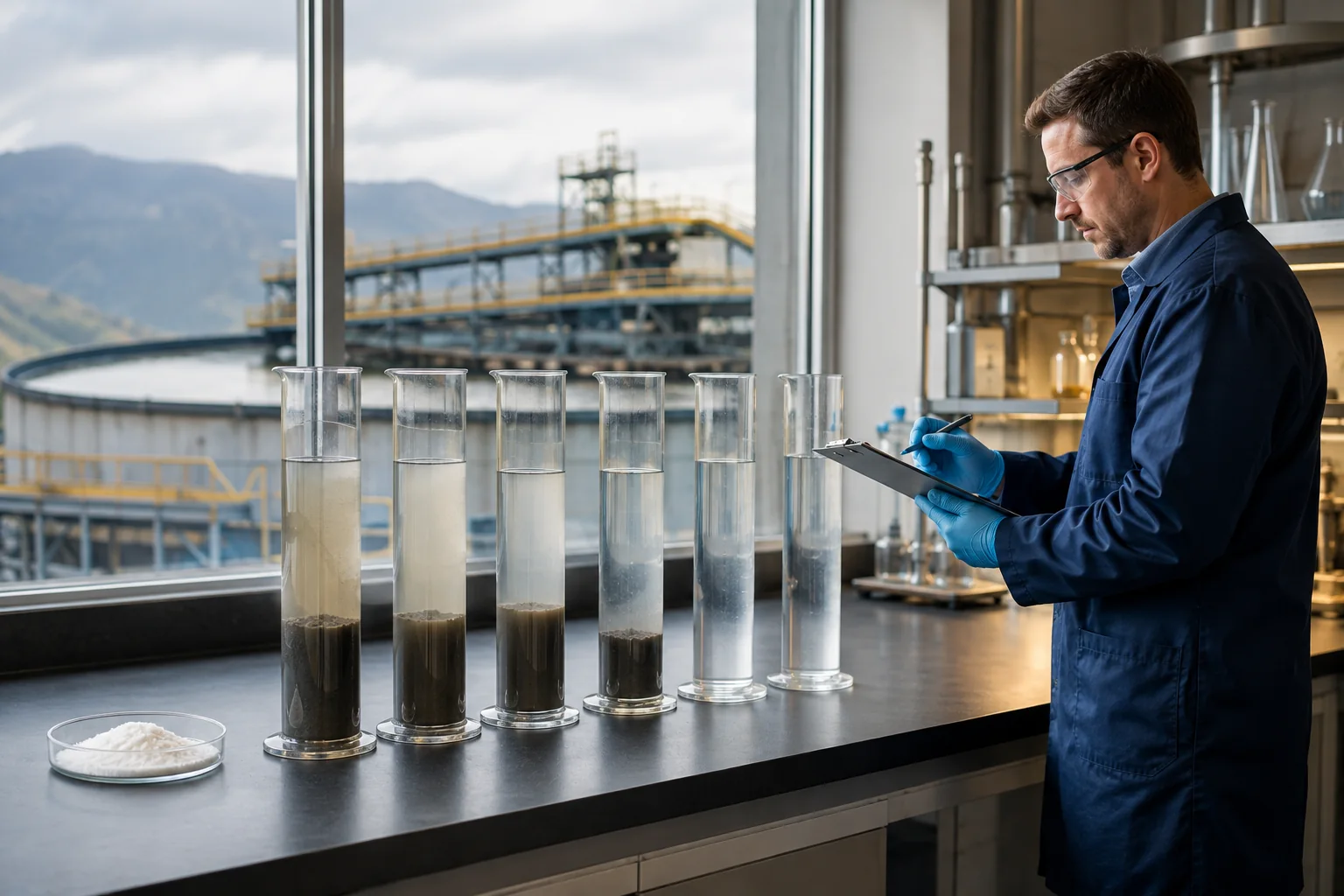
Anionic polyacrylamide selected in clean laboratory water can respond differently in a mature recycle circuit. A procurement specification for hard or saline water needs evidence on the real water chemistry, not an unsupported salt-tolerant label.
Separate preparation water from process water
Record both sources. The make-down unit may receive softened water while the separator sees concentrated recycle water, or the same recycled source may serve both duties. These are different exposure conditions.
Measure relevant conductivity, hardness, pH and temperature, adding ion-specific analyses when the application requires them. Conductivity alone cannot identify calcium, magnesium or other components that affect polymer and particle interactions.
Preserve the circuit chemistry during sampling
Collect representative water and slurry from the intended addition point. Record water balance, recent rain, makeup fraction and reagent changes. Do not dilute a difficult sample with fresh water merely to make transport or bench work convenient.
Include normal and accumulated-water conditions where practical. A mine or wash plant may need seasonal or campaign-specific limits rather than a single laboratory acceptance point.
Disentangle preparation failure from product mismatch
Compare stock prepared under the intended operating conditions and, where useful, a controlled reference water. Keep mass, concentration, age and mixing documented. Check fisheyes, transfer and actual delivered stock.
Then test the prepared solutions on the same process feed. If preparation explains the lost response, buying a higher-dose grade may conceal the real constraint. If properly prepared products differ on the process water, a focused chemistry screen is justified.
Judge the operating envelope
Measure dose response, clarity, settling, compaction and downstream behavior at the water conditions that matter. Repeat finalists before accepting a claim of improved tolerance. Do not infer long-term performance from a clear solution or one fast settling point.
Use the anionic-profile comparison route to examine adjacent candidates while controlling the molecular range where possible. Record any water range outside which the supplier has no qualifying evidence.
Make the quotation conditional on evidence
Specify water analyses, test conditions, product identity and practical acceptance limits. Clarify whether the proposal requires changes in preparation water or equipment that affect delivered treatment cost.
Submit the actual water record through the recycle-water APAM enquiry. Keep later water-chemistry changes in the requalification plan; a successful purchase under one balance does not guarantee unrestricted performance as salts and upstream reagents accumulate.