
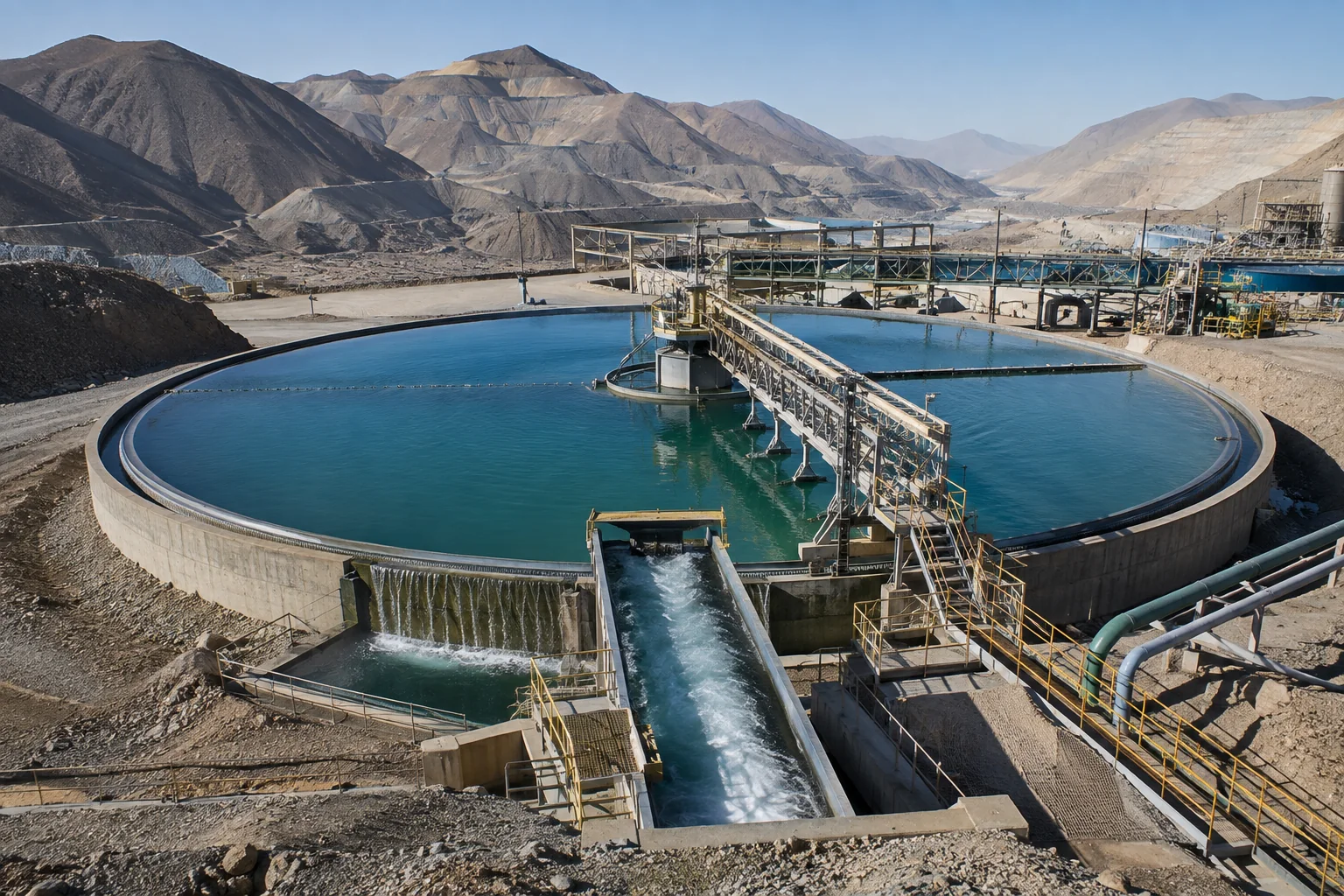
A copper-tailings APAM order can influence more than thickener overflow. Recovered water may return salts and residual process chemistry to upstream operations, so polymer qualification needs an agreed water-reuse boundary as well as the solids-separation result.
Define the water destination
Identify which operations receive recovered water and which properties they control. Record the ore campaign, slurry solids, fines, pH, conductivity, hardness and relevant flotation or other reagent history.
Separate visible clarity from dissolved chemistry. A clear overflow is not evidence that all dissolved species or residual reagents have been removed. Keep the upstream water-quality decision with the plant team responsible for that process.
Sample without losing the difficult fraction
Take representative slurry and process water at the intended polymer addition point. Preserve ultrafines and document sample age, transport and mixing. Compare samples from normal and difficult campaigns where possible.
Use the actual preparation-water source. If laboratory fresh water is used for practical reasons, label that limitation and verify the finalist under production preparation conditions before ordering a commercial replacement.
Measure the thickener envelope
Screen product and dose using a consistent method. Record settling, supernatant quality, sediment volume and a relevant shear response. At plant scale, add solids flux, feedwell conditions, bed level, rake condition, underflow and pumpability.
The tailings-thickener guide gives the operating framework. The commercial trial should identify which endpoints are mandatory and which improvements are optional, so a large visual floc does not override a failed limit.
Keep recycle effects measurable
Agree a water-reuse observation plan before the trial, including sampling locations, timing and relevant analyses or process indicators. Avoid assigning a change in flotation or washing to polymer without controlling other operating changes.
Allow sufficient circuit residence for the comparison. When a recycle issue appears, compare chemistry, dosage, preparation and water balance with the benchmark. Retain raw data and explicitly state where causation remains uncertain.
Release supply with bounded conditions
Specify the exact code, trial envelope, accepted dose range and water-reuse conditions. Include a response plan for feed or water changes and preserve benchmark stock during the controlled transition.
Send the thickener and recycle record through the copper-tailings APAM enquiry. Request a quotation tied to the qualified duty rather than a general mining-polymer offer. Approval at one copper circuit does not establish suitability for every ore or water balance.