
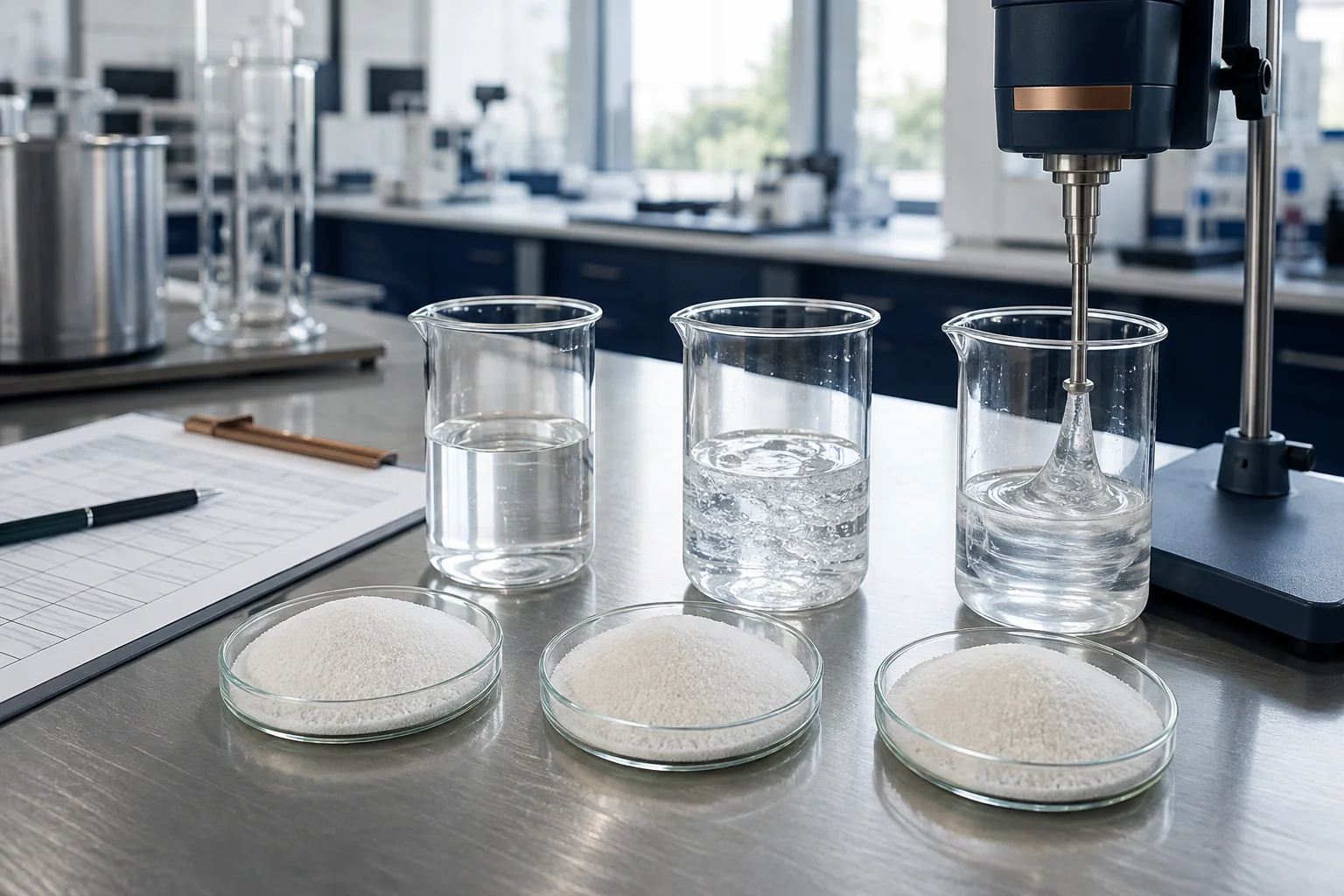
Anionic polyacrylamide, commonly shortened to APAM, is a water-soluble polymer family whose chains carry negative ionic groups. Industrial grades are used mainly as flocculants, coagulant aids or rheology modifiers, but the name describes a family rather than one interchangeable chemical product.
How the polymer is described
Commercial APAM is commonly based on acrylamide with anionic functionality introduced through copolymer composition or hydrolysis. Suppliers may describe molecular weight, anionic character, active content, particle size, solution viscosity and residual monomer limits. Test method and units matter, so two numbers from different documents may not be directly comparable.
Dry powder is widely used where economical transport and continuous preparation are important. Other product forms exist, but powder and emulsion cannot be compared by equal as-supplied mass unless active content and inversion or hydration requirements are included.
How APAM forms floc
A dissolved polymer chain can attach at available sites and extend into the water, connecting more than one particle. This bridging creates larger structures that settle, float or filter more readily. Anionic polymers can work on negatively charged mineral systems through specific surface sites, multivalent ions or coagulant-formed microfloc; simple charge labels do not describe every interaction.
The process needs enough polymer distribution for contact and then sufficiently gentle mixing for growth. Too little product leaves fines. Too much or poorly distributed product can create haze, weak floc, sticky solids or unnecessary cost. Severe shear after bridging can fragment the result.
Where it is commonly screened
Mining tailings, mineral thickeners, aggregate wash water and industrial clarification after PAC, alum or ferric are common APAM screening duties. Some filtration and paper processes also evaluate anionic products. Organic biological sludge frequently begins with a cationic screen instead, although representative testing remains decisive.
Application descriptions are starting points. Mineralogy, clay fraction, pH, salts, hardness, process reagents, solids concentration, temperature and equipment change the response.
What APAM cannot establish by itself
The product name does not prove suitability for drinking water, food contact, discharge compliance or any regulated use. Those decisions require the correct product documentation, applicable local requirements and process approval. APAM also cannot repair a failed precipitation step, blocked filter, short-circuiting clarifier or uncalibrated feeder.
Avoid universal dose tables. A credible dose comes from representative bench work, active-mass calculation and a controlled plant run.
The minimum selection record
Record feed origin, solids, particle or mineral description, pH, conductivity, temperature, upstream chemicals, separator, present product and dose, target result and supply demand. Compare a focused product set at equal preparation and active dose.
Begin with the APAM product range and carry the successful product code and operating window into the purchasing record.
How to read a supplier answer
A useful answer names a product code, explains why its molecular and anionic profile belongs in the sample set, and asks for the process information that remains unknown. It should distinguish a screening recommendation from an approved plant condition.
Treat a generic claim that one APAM grade works for every wastewater, mine or clarifier as a warning. Feed-specific testing is not a sales delay; it is the evidence needed to prevent repeated shipments of the wrong product.