
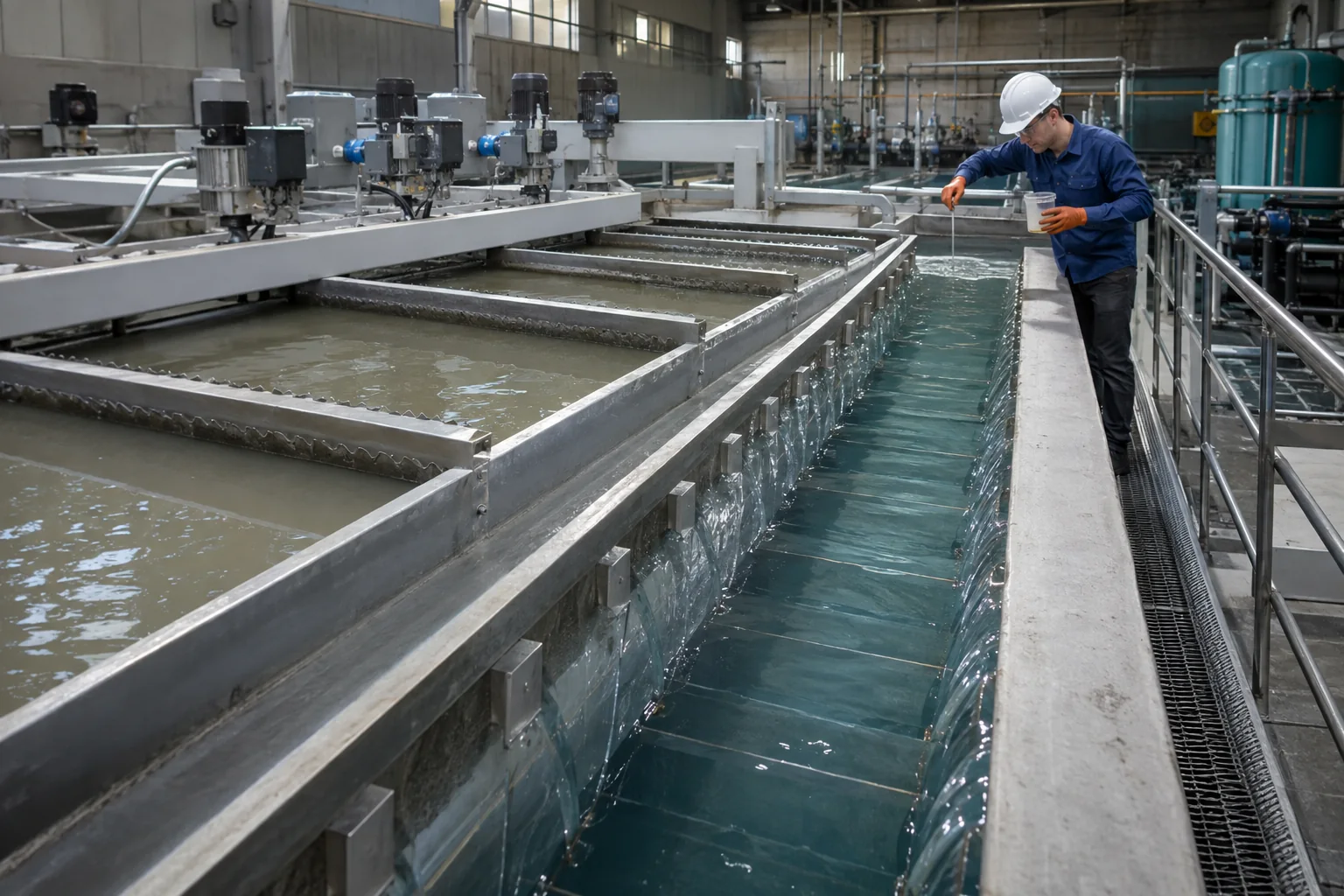
The most useful way to organize anionic polyacrylamide uses is by separation duty. The same plant may need different APAM profiles for clear overflow, high thickener flux or fast filter drainage, and a product that succeeds at one endpoint can fail another.
Clarification after particle destabilization
In industrial water treatment, PAC, alum, ferric or pH adjustment may first create destabilized particles or precipitates. APAM is then tested as a bridging aid to increase floc size and settling or flotation response. The chemical sequence and mixing stages must be preserved during the comparison.
Measure raw and treated turbidity or suspended solids, settling time, sludge volume and downstream dewatering. Coagulant-only and untreated controls show whether polymer adds value.
Mineral and tailings thickening
Thickeners require more than clear water. The polymer must support solids flux, feedwell conditions, bed stability, underflow density and pumpability while protecting recycled-water quality. Clay-rich fines and recycle salts can shift demand across ore campaigns.
Use settling and compaction tests for screening, then confirm at plant scale with feed solids, rake condition and residence held as stable as practical. See the mining-tailings route for the full record.
Sand and aggregate water recycling
Wash plants use APAM to capture silt, clay and crusher fines so water can return to screens and washers. Closed-loop operation changes the water as dissolved salts and ultrafines accumulate, so fresh-water tests alone can mis-rank products.
Track clarifier overflow, sludge withdrawal and the filter press or belt if one follows. High apparent settling speed is not valuable if the resulting sludge is sticky or difficult to dewater.
Filtration and solids capture
Mineral and inorganic slurries may use APAM ahead of pressure, vacuum or gravity filtration. The relevant endpoints include filtrate solids, drainage or filtrate-volume curve, cake moisture, cake release, cloth condition and cycle time.
Do not select a filtration grade from cylinder settling alone. Pressure, media and shear alter the result.
Other industrial duties
Papermaking, enhanced oil recovery, soil erosion control and other processes use particular polyacrylamide products under their own performance and regulatory requirements. A grade approved for one duty should not be transferred to another without documentation and testing.
The product form, residual specifications, purity requirements and dose basis can be materially different.
Choose by evidence, not a use list
For every use, document feed condition, useful charge family, candidate product codes, preparation, active dose, mixing and equipment endpoint. An application list creates the shortlist; the measured operating window creates the purchase decision.
Use the representative process brief to request samples against the actual duty.
When the application result changes
Do not assume that an apparent product failure requires a different shipment. First compare current feed solids, water chemistry, preparation age, calibrated dose, injection condition and separator load with the approved record. Sudden failure often points to delivery or process change.
If the feed envelope has genuinely moved, repeat a compact screen rather than increasing dose without a limit. The new operating window should be recorded beside the new raw-water, ore or production condition.