
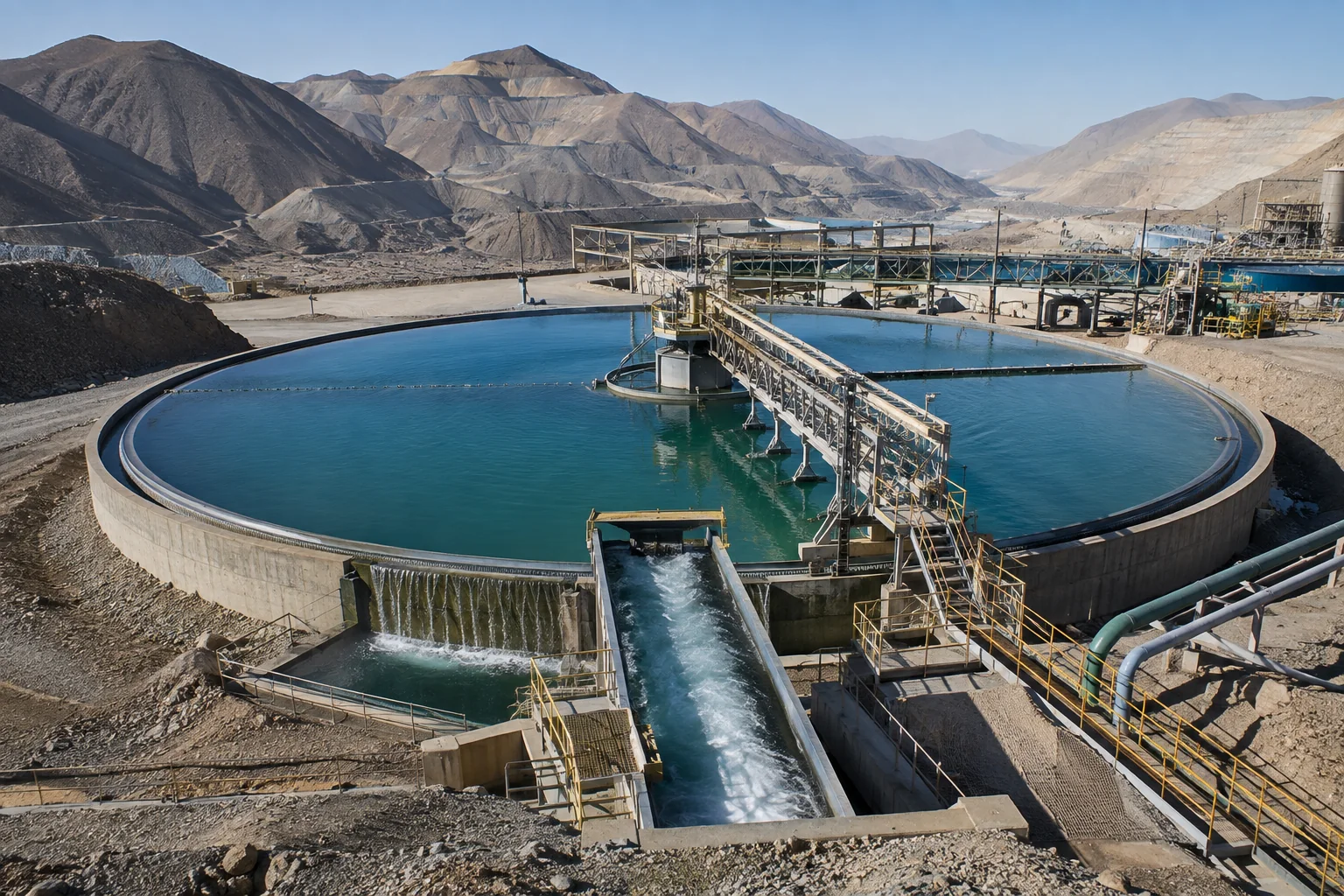
Tailings response changes with ore campaign, grind, clay fraction, process reagents and recycled-water chemistry. Anionic polyacrylamide is frequently part of the screen, but the approved grade must satisfy the thickener rather than only produce attractive floc in a cylinder.
Build a representative tailings record
Provide ore type, particle-size distribution, solids concentration, density, mineralogy or clay indicators, pH, conductivity, hardness and residual flotation or leaching reagents. Sample stable and difficult operating periods without losing the finest fraction.
Use process water for preparation and testing when possible. Recycle ions can shift product ranking compared with fresh laboratory water.
Measure settling and compaction
At bench scale, record interface velocity, supernatant clarity, final bed volume and response to a defined shear step. Include a low, middle and high dose on active polymer per dry solids. Repeat finalists on a second sample.
At plant scale, add solids flux, feedwell dilution, bed level, rake torque or pressure, underflow density, pumpability and overflow solids. Allow residence time after each controlled change.
Protect the rest of the circuit
Recovered water returns dissolved species and residual chemistry upstream. Check effects on flotation, washing or leaching rather than approving water on appearance alone. Review underflow rheology and transport when higher compaction is targeted.
A lower polymer dose is not lower cost if water recovery falls or thickener capacity constrains production.
Send the thickener brief
Include current polymer and dose, make-down, feedwell arrangement, overflow and underflow targets, throughput, monthly demand, packaging and destination. Use the tailings thickener guide to structure the test.