
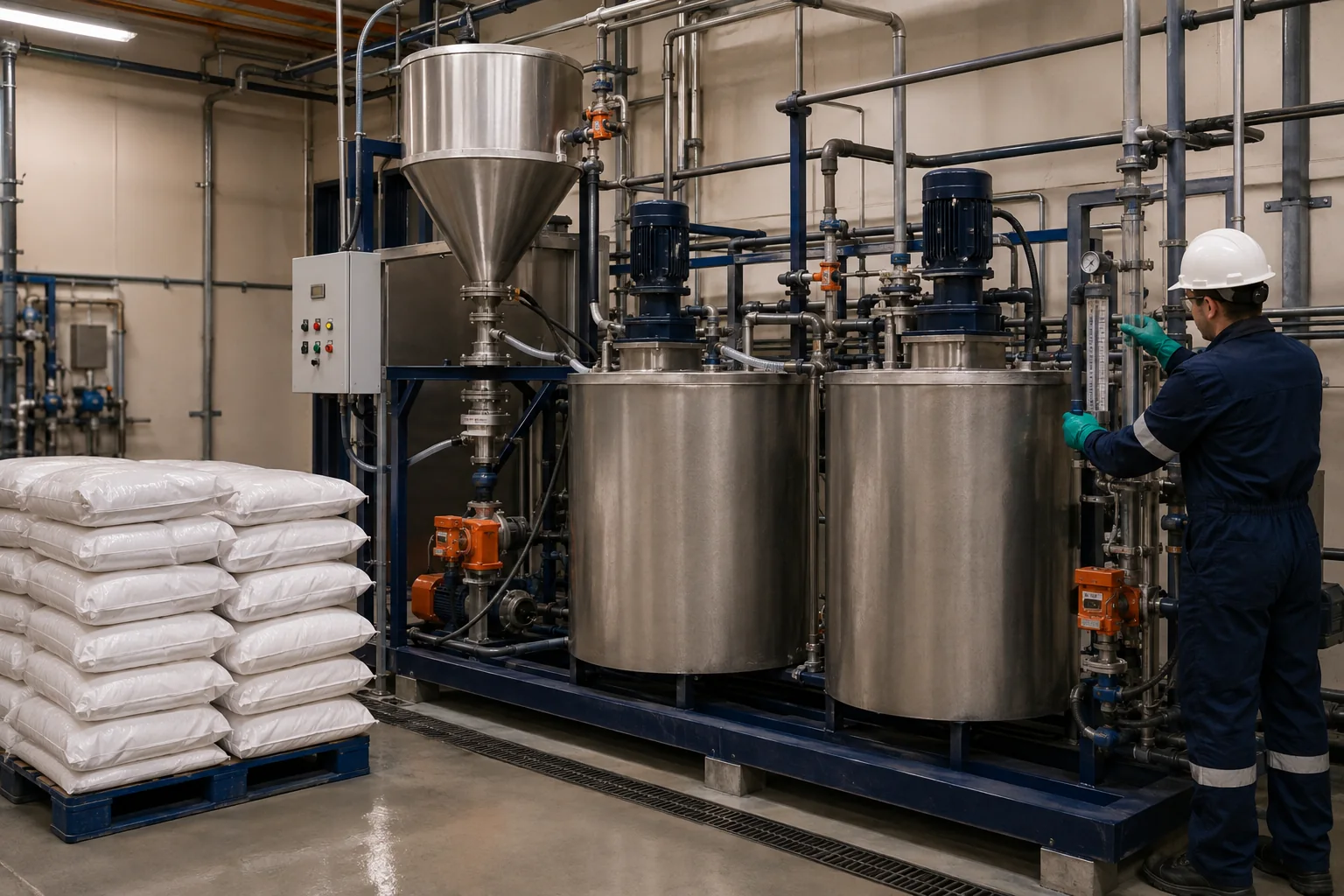
Correct anionic polyacrylamide powder preparation separates the particles before they swell, then gives the chains enough time to hydrate under controlled agitation. Dumping powder into still water creates gel-coated lumps whose dry cores may never dissolve during the usable batch period.
Use suitable preparation water
Record water source, temperature, pH, conductivity and hardness. Use the supplier's product instructions when they specify a range. Extremely cold water slows hydration, while contaminated recycle water can change viscosity or performance.
Keep the tank and lines clean of incompatible chemicals. Polymer contact with concentrated coagulant can create deposits before the product reaches the process.
Choose a workable stock concentration
The appropriate stock concentration depends on product, feeder, mixing, tank capacity and viscosity. A more concentrated solution saves tank volume but becomes harder to wet, mix, transfer and distribute. Do not adopt a universal percentage without confirming the specific TDS and make-down equipment.
Calculate powder and water feed from actual calibrated rates. Secondary dilution at the injection point changes delivery volume, not active polymer mass.
Induct powder as separated particles
Establish water flow and mixing first. Feed powder steadily into a well-formed wetting zone so each particle contacts water before touching swollen polymer. Avoid dumping bags, allowing condensation around the feeder or sending clumps through a small eductor.
Inspect the surface and recirculation for fisheyes. Stop and correct the induction condition rather than hiding poor wetting with more mixing time.
Mix without unnecessary shear
Initial agitation must distribute powder through the tank. Once chains hydrate, prolonged high shear, high-speed pumps or severe restrictions can reduce effective molecular size. Use equipment designed for polymer preparation and transfer.
Confirm that the mixer reaches the whole vessel without air entrainment or dead zones. Vortexing and foam are not evidence of good hydration.
Allow controlled maturation
Record batch start, powder completion and time when the solution becomes available. Compare treatment response at defined ages if production pressure encourages shorter maturation. A solution can look uniform before it reaches stable performance.
Use prepared solution within the supplier's recommended period. Avoid blending old uncertain stock into a new batch during a product trial.
Verify the full delivery path
Check tank level, transfer pump, screens, valves, calibration column, secondary water and injection point. Gel accumulation, blocked lines and inaccurate flow can imitate a bad product or wrong dose.
Keep a preparation log with product code, lot, water, concentration, temperatures, times and observations. Link it to the rapid-wetting profile only after separation performance is confirmed.
Diagnose an inconsistent stock solution
If viscosity or treatment response changes between batches, check actual powder mass, water flow, tank working volume, induction time, temperature and solution age. Sample from equivalent points after the tank is homogeneous. Do not compare a fresh top sample with aged material near the outlet.
When fisheyes appear, document feeder humidity, wetting-cone condition and powder addition rate. Screening out the lumps may protect equipment, but it does not recover the missing active polymer or make that batch suitable for a controlled trial.