
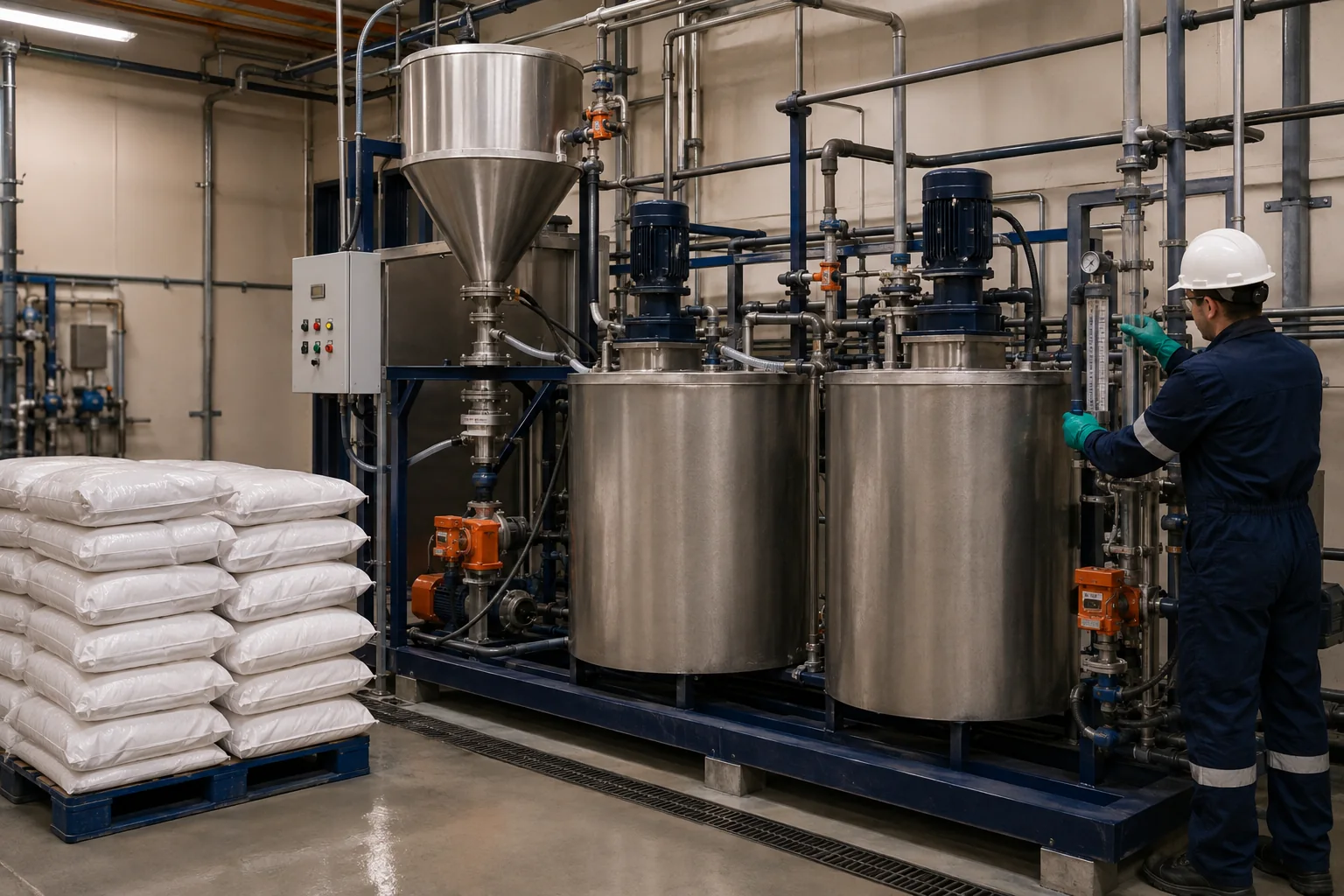
Rapid wetting is useful where make-down capacity or operator time limits production, but wetting is not the same as full hydration. The selected powder still has to form a uniform stock solution and deliver the required separation result.
Define the preparation constraint
Record powder feeder range, wetting device, water flow and temperature, stock concentration, mixer type, tank volume, residence time and daily demand. Identify whether the bottleneck is powder dispersion, hydration time, solution viscosity, tank capacity or feeder turndown.
A visually clear solution can still contain incompletely hydrated polymer. Compare solution consistency and treatment response at controlled ages before shortening the maturation standard.
Prevent fisheyes and chain damage
Introduce powder as separated particles into a well-formed water zone. Avoid dumping, wet surfaces around the feeder and excessive stock concentration. Provide initial dispersion without prolonged high shear after the chains begin to hydrate.
Inspect screens, transfer pumps and injection valves for gel accumulation. Undissolved material wastes product and can block lines, while aggressive mechanical correction may reduce effective chain length.
Approve powder and process together
Run the same feed test with stock prepared at several practical ages. Record settling or filtration alongside feeder output, water demand and operator observations. The commercial decision should include reliable preparation at expected ambient conditions.
Document bag handling, storage humidity protection and lot traceability with the quality and supply plan.