
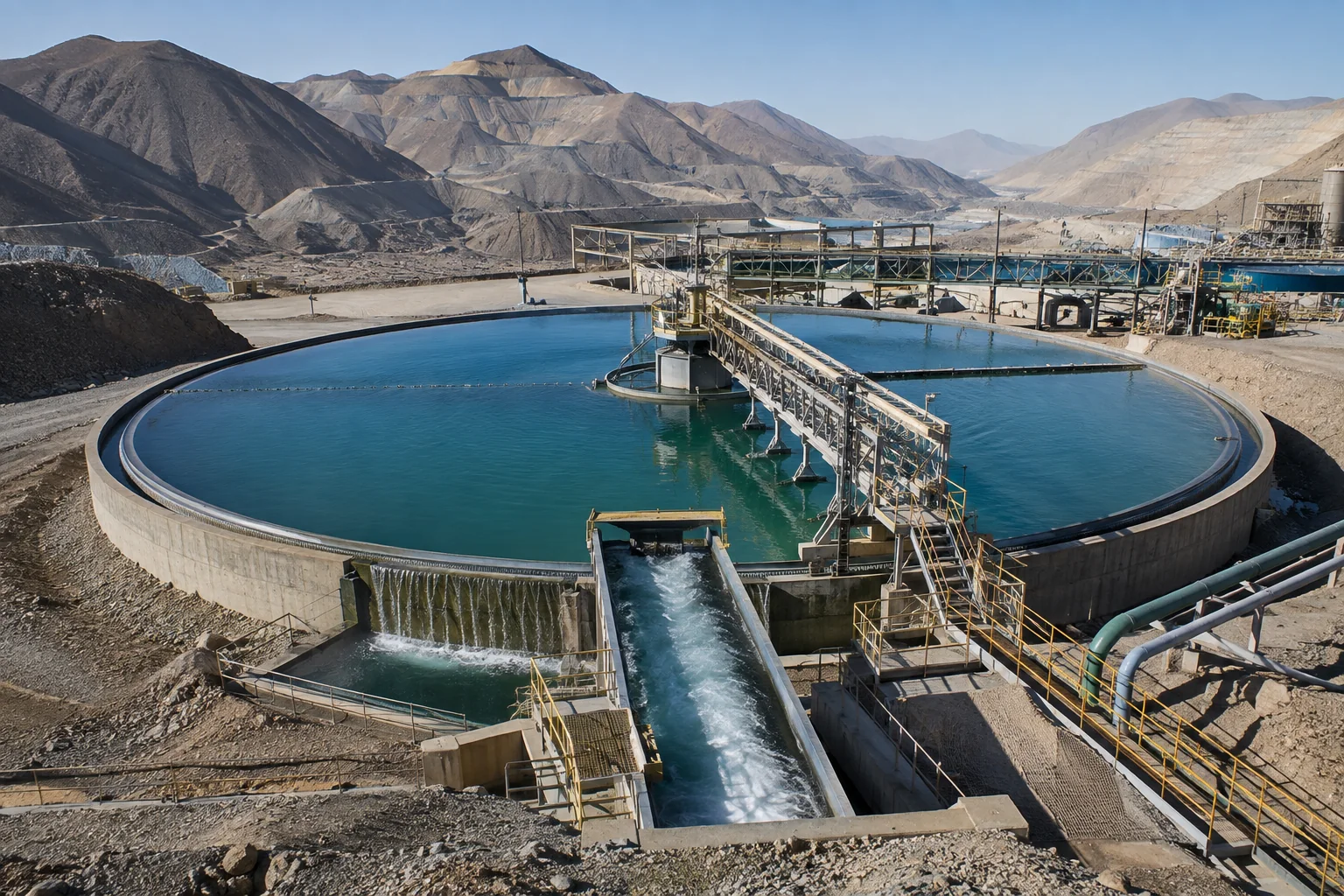
A mining tailings thickener converts a variable slurry into reusable overflow and transportable underflow at the required solids throughput. APAM selection therefore has to balance rate, clarity, compaction, rheology and equipment condition rather than optimize one settling cylinder observation.
Define the feed envelope
Record ore campaign, grind, particle-size distribution, clay fraction or mineralogy indicators, solids concentration, density, pH, conductivity, hardness, temperature and residual reagents. Include recycled water and difficult feed periods.
Take samples that preserve ultrafines and age. A tailings container that settles during transport can lose the fraction that controls overflow haze.
Screen settling under controlled preparation
Prepare each APAM product with the same water, concentration, hydration and age. Dose on active mass per dry solids. Use consistent polymer contact, floc growth and a defined shear step that reflects the feed path.
Record interface position over time, supernatant turbidity or solids, final bed volume and visible floc behavior. Repeat finalists rather than relying on one fast curve.
Separate feedwell problems from product problems
At plant scale, inspect dilution, injection distribution, feedwell energy and residence. A concentrated polymer stream can short-circuit; excessive energy can fragment floc; insufficient contact leaves untreated slurry.
If bench response is strong but plant overflow is poor, verify calibration, solution delivery and hydraulics before replacing the product.
Follow the thickener operating state
Hold throughput and mechanical controls as stable as practical during the comparison. Record solids flux, overflow solids, bed level, rake torque or pressure, underflow density, pumpability and water recovery. Allow each step to reach a defensible state before sampling.
Higher underflow density can raise yield stress and transport demand. Confirm the value of compaction against pumping and downstream deposition requirements.
Check recycle consequences
Clear-looking overflow can still return dissolved salts and reagents. Review effects on flotation, washing, grinding or other upstream operations. If the circuit accumulates hardness or salinity, repeat polymer checks on the mature water condition.
Track trends across ore campaigns so the approved dose band has a real feed context.
Compare commercial outcomes
Calculate active and as-supplied consumption, then include throughput, water recovery, downtime, underflow transport and inventory. Product price per kilogram is only one part of the thickener result.
Send the operating record through the mining-tailings application route for a focused sample plan.
Troubleshoot a clear bench result and cloudy overflow
Confirm that the plant receives the same product concentration and active dose used in the bench test. Inspect feeder calibration, dilution water, blocked lines, injection distribution and the distance between polymer contact and the feedwell. Sample the prepared solution rather than assuming the tank label is correct.
Then review feedwell energy, hydraulic short-circuiting, bed level and sludge withdrawal. When preparation and delivery are sound, repeat the bench test on current feed to determine whether ore, fines or recycle chemistry has moved outside the approved envelope.
Record the timing of the overflow failure against ore changes, storms, recycle-water balance and underflow interruptions. A time-linked pattern helps separate intermittent hydraulic loading from a steady mismatch in APAM profile.