
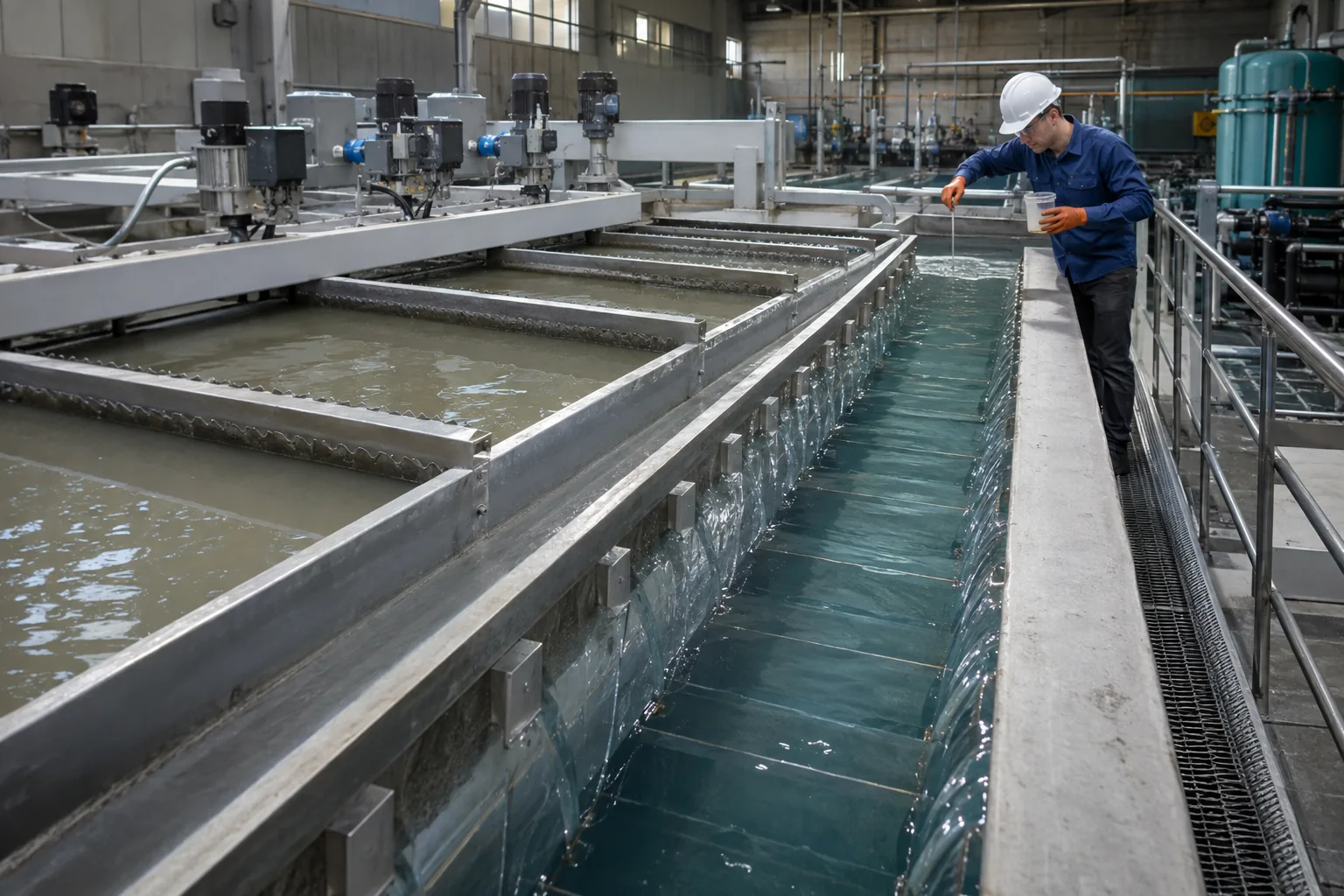
Anionic polyacrylamide may be screened to bridge metal-hydroxide solids after precipitation or coagulation. The purchase decision must distinguish forming the solid phase from capturing it: a polymer cannot be assumed to remove dissolved metals that remain in solution.
Establish the upstream treatment baseline
Document the production source, metal species of concern, pH-control sequence, precipitation reagents, coagulants and relevant complexing chemicals. Record variability between production batches.
Agree which results are dissolved and which are total. Where the discharge or reuse requirement calls for both, use the plant's approved sampling and analytical method. A clear supernatant alone cannot demonstrate compliance or complete metal removal.
Sample at the intended polymer addition point
Prepare representative feed through the existing upstream chemistry before comparing polymers. Include untreated and upstream-chemical-only controls where they clarify the decision.
Keep pH, reagent concentration, addition order and mixing fixed during the first screen. Otherwise a different precipitation condition can be mistaken for a better APAM grade. Any change in chemical program needs its own controlled comparison.
Measure capture and sludge behavior together
Record floc formation, settling time, supernatant solids or turbidity and the relevant analytical endpoint. Include sludge volume and subsequent dewatering when disposal and filter capacity affect the purchase.
Compare adjacent molecular or anionic profiles on a documented dose basis. Keep alternative ionic families available if a correctly prepared APAM set is ineffective. The charge-family guide avoids assigning a polymer solely from the industry label.
Separate plant hydraulics from chemical selection
Verify preparation, solution delivery, contact time, clarifier loading and sludge withdrawal. Fragile floc may break after a good bench test; poor distribution can leave untreated zones.
Repeat the finalist at stable operating conditions and allow process residence. Keep raw measurements and feed history. Do not use a higher-dose product to mask an unresolved precipitation or equipment problem.
Qualify the quotation
Provide the treatment sequence, analytical definitions, accepted endpoint, equipment, trial quantity and expected demand. Ask the supplier to identify the precise role of APAM in the proposed program.
Send these records through the industrial precipitation APAM enquiry. Specify the approved code and process boundary in the order; neither a COA nor a floc photograph is a guarantee of regulatory compliance under every production batch.