
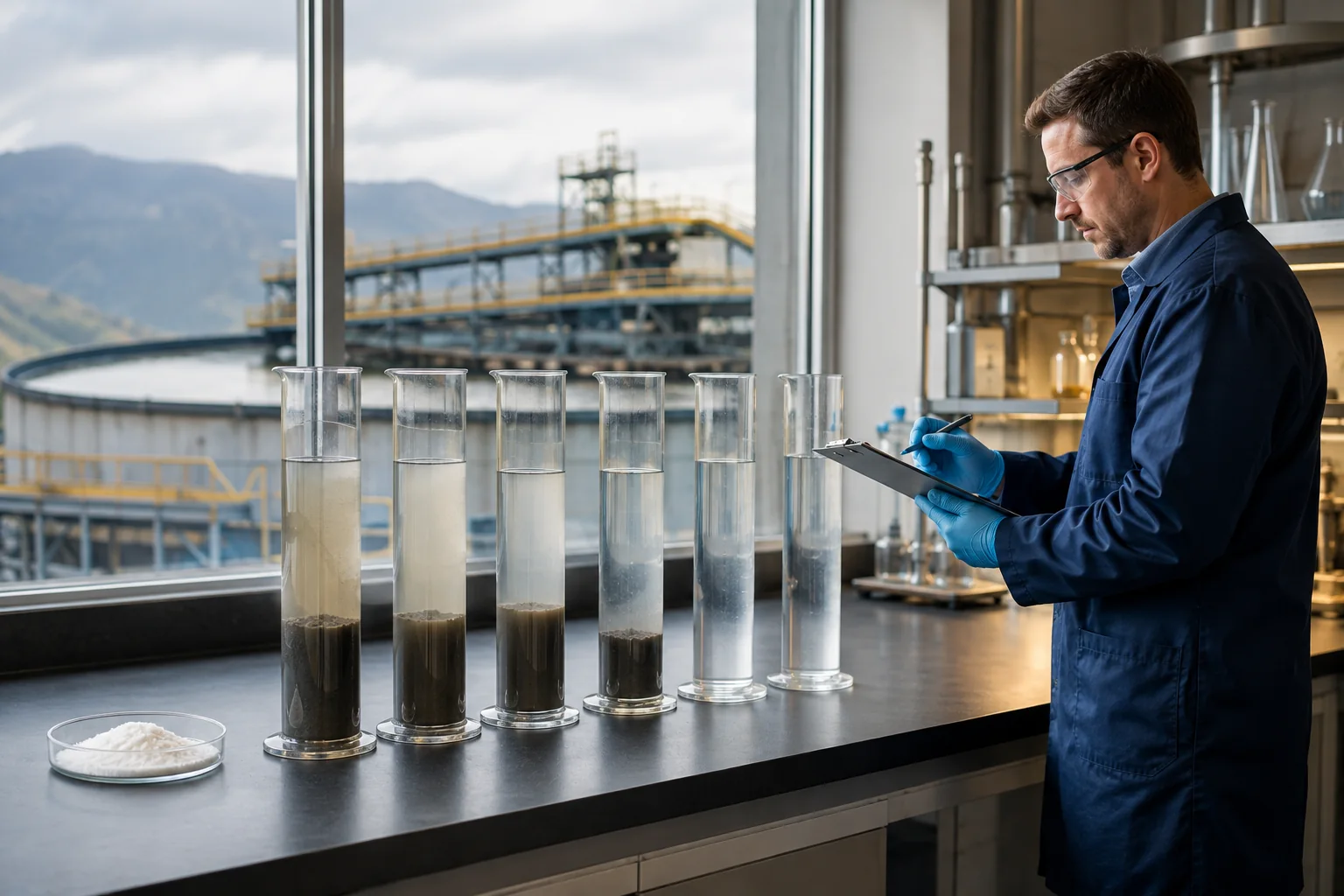
An APAM enquiry for kaolin or clay processing must distinguish valuable product solids from waste fines. The same instruction to make particles settle can be helpful in a waste-water clarifier and unacceptable in a stream that must remain dispersed for further processing.
Name the stream before naming a polymer
Describe whether the duty is product recovery, waste thickening, water clarification or filter conditioning. Identify the value stream and the next process step. Include product brightness, particle classification or other quality constraints where they apply.
Provide mineral composition, fine-particle distribution, solids, pH, water chemistry and dispersant history. Clay-rich suspensions can change strongly with reagent sequence; a sample taken before dispersant addition does not represent one taken afterward.
Set boundaries around product quality
Ask the process owner which properties polymer treatment may alter and how they will be tested. Do not infer suitability for paper, coatings or another final use from successful water clarification.
Where product contamination or carryover is a concern, define the relevant analytical or application check. Claims such as no effect on downstream quality require evidence for the actual grade and circuit, not a generic anionic-polymer description.
Compare candidates in the existing chemistry
Hold dispersant, coagulant and pH settings stable during the first screen. Prepare samples consistently and record code, batch, active basis, solution age and mixing. Include a benchmark and untreated control.
Measure clarity, settling, sediment volume and, where relevant, filtration. Include the difficult fine fraction rather than selecting only easily settled material. Use the molecular and anionic-profile framework to request an interpretable sample set.
Check underflow and reuse consequences
A compact bed that cannot be pumped or redispersed may fail the duty. Record the intended solids-handling requirement and test it alongside settling. If water is recycled, include accumulated salts and residual reagents in the acceptance record.
Scale the finalist under stable conditions and allow process residence. Record any equipment adjustment required by the new grade so its labor or production cost remains visible in the commercial comparison.
Buy the accepted application, not a universal clay grade
Keep the exact code, chemical sequence, useful feed range, preparation and required product or waste-stream endpoints with the order. Separate approvals for different process streams.
Use the clay-processing APAM brief to request samples and a trial quantity. Ask the supplier to state untested assumptions. If the process objective is dispersion rather than flocculation, reconsider the chemical category before buying more APAM.