
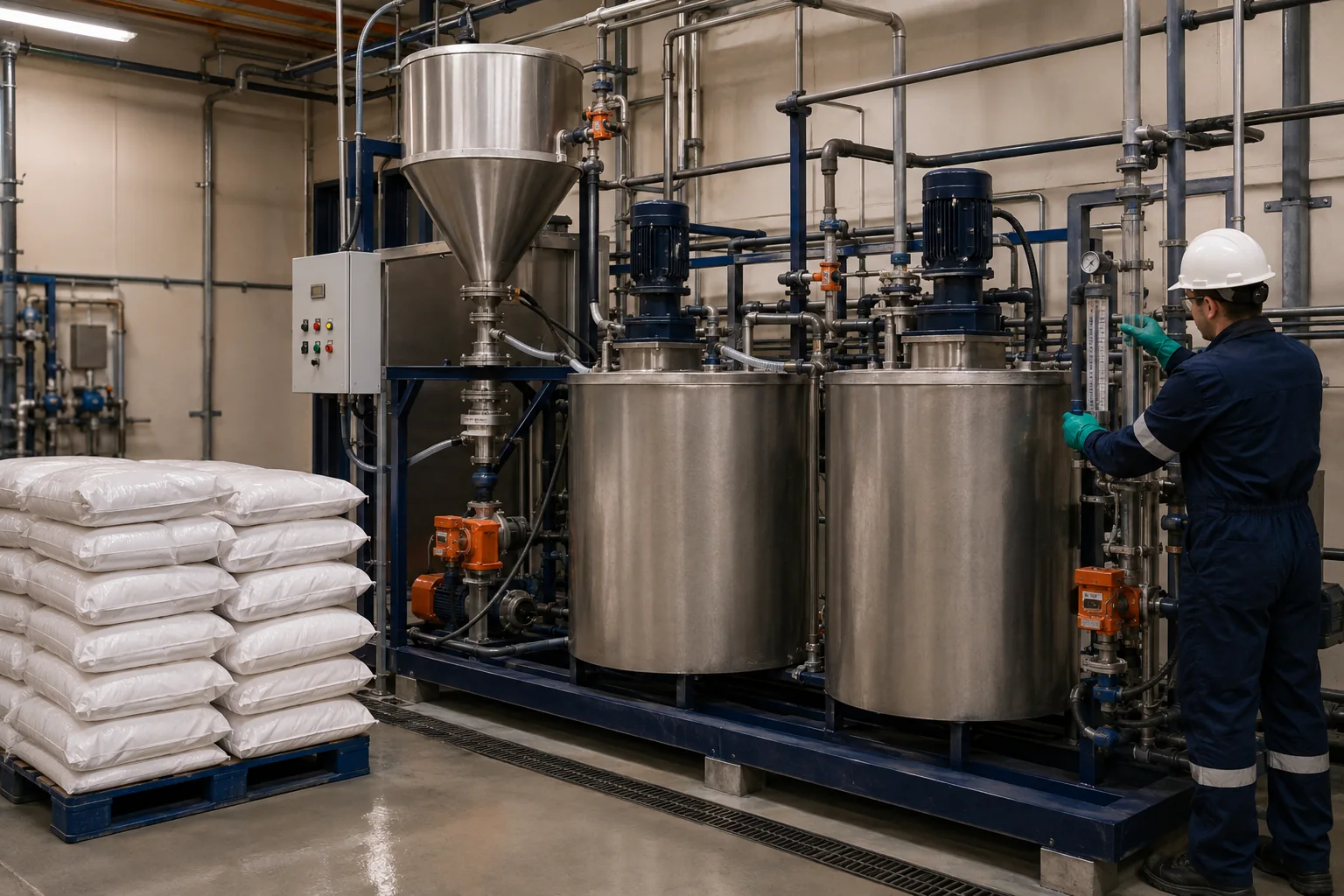
An APAM quotation can look economical while exceeding the make-down system's usable output. Procurement needs to compare qualified treatment demand with stock that the equipment can reliably prepare, mature and deliver at the required time.
Calculate demand on a documented basis
Use measured process throughput and accepted dose to estimate active or as-supplied polymer demand. Keep the basis explicit and include peak solids loads where the plant doses against dry solids.
Convert the requirement to stock-solution flow at the intended concentration. Do not change concentration only on paper: increasing it can alter wetting, viscosity, mixing, pump delivery and injection distribution. Check the actual product instructions.
Use working volume rather than the tank nameplate
Record effective tank volume, batch filling time, powder induction, maturation, drawdown and reserve. Account for compartments, dead volume, level controls and periods when freshly prepared solution must not be used.
Estimate continuous usable output from the preparation sequence, not just pump capacity. A dosing pump that can empty the tank faster does not prove that the make-down unit can continuously supply hydrated stock.
Test low-rate and peak-rate operation
Compare weighed powder feed at normal and low demand. Check pulsing, bridging, moisture buildup and wetting-device behavior. Observe concentration and usable stock age during peak operation.
Screen for fisheyes and deposits, then confirm the stock's treatment response. A label such as rapid wetting is not a substitute for the preparation-sensitive powder qualification under the installed equipment's conditions.
Protect transfer and injection
Review pump type, suction, line restrictions, calibration, secondary water and the actual contact point. Verify that the stock reaches the separator at the intended rate without damaging excessive shear or local overdose.
Keep water temperature and seasonal operating conditions in the approval. If qualified output relies on warmer or cleaner water than the plant can supply, the equipment or product proposal needs to acknowledge that dependency.
Ask for an integrated supply proposal
Provide demand calculations, tank sequence, feeder range, water data and accepted separator result with the APAM make-down compatibility enquiry. Ask the supplier to distinguish product selection from equipment changes.
Approve the exact grade and preparation standard together. Record spare capacity and action when demand exceeds it; buying more bags cannot correct a preparation bottleneck that limits usable solution production.