
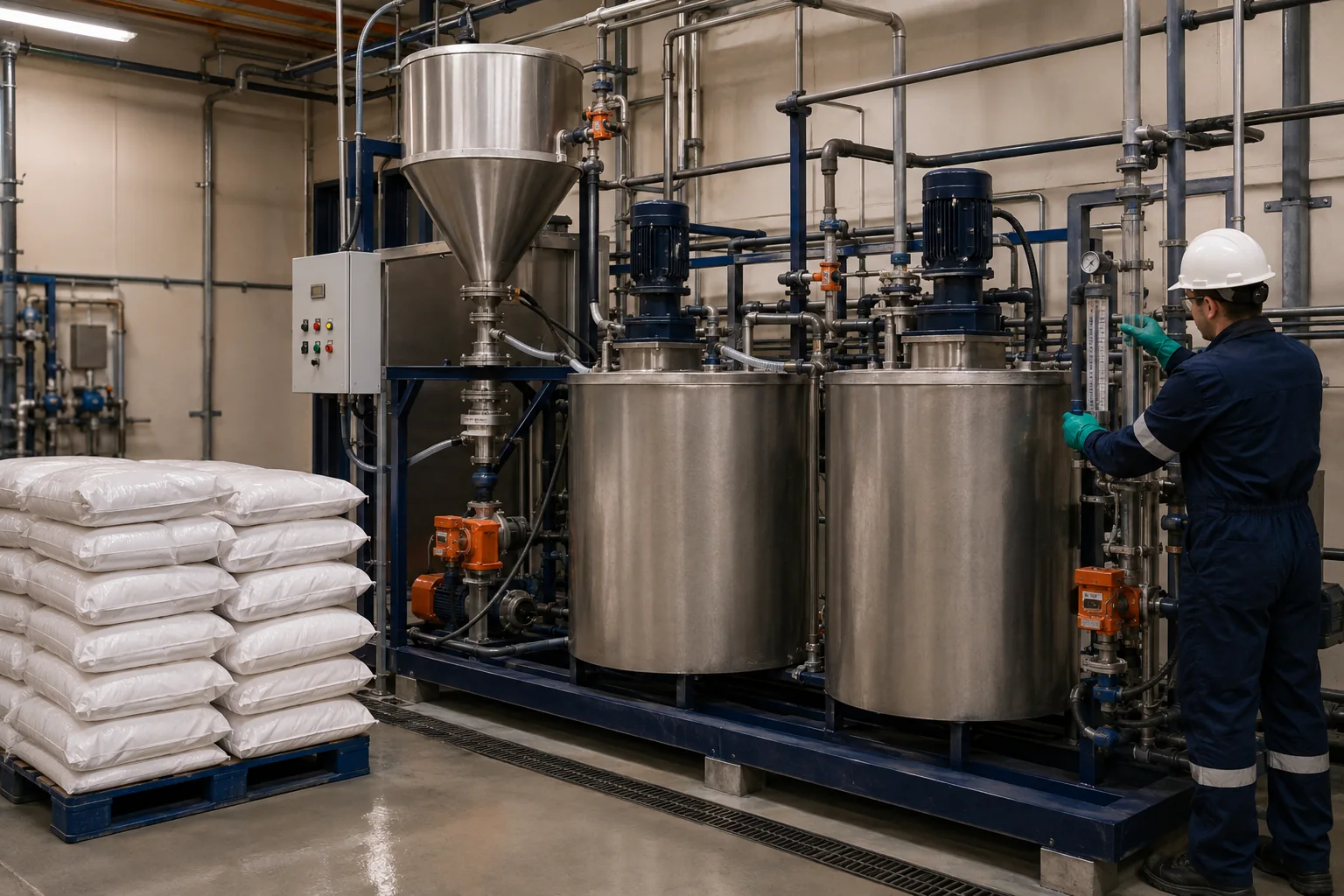
Buying anionic polyacrylamide powder for an existing make-down unit requires more than matching a mesh label. The delivered particle distribution must feed consistently, wet as separated particles and produce usable stock within the plant's available maturation capacity.
Request a distribution rather than one mesh number
Ask which sieve standard and test method define the supplier's particle-size statement. A nominal mesh can conceal different fractions of fines and oversized granules. Confirm what is guaranteed and what is only typical.
Keep moisture, flow behavior and dust handling separate from particle size. Fine particles can wet quickly when properly dispersed but may bridge, dust or form surface gels in unsuitable equipment. Coarser material can require a different hydration allowance.
Describe the installed powder path
Provide bag or bulk-bag discharge arrangement, hopper geometry, feeder type, calibrated mass range, wetting device and water flow. Include ambient humidity, water temperature and the maximum period between production shifts.
Check the low-load condition as well as peak throughput. A powder that handles at maximum rate can pulse at turndown. Compare weighed output at several normal settings and record interruptions, buildup and manual intervention.
Qualify usable solution, not apparent wetting
Keep concentration, temperature and mixing consistent with production. Check for fisheyes, screen deposits, solution uniformity and treatment response at the age when the plant intends to use the stock.
A fast visual disappearance of particles does not prove full hydration. The powder dissolution method separates induction, maturation and delivery checks. Use that distinction when assessing a rapid-wetting claim.
Run a practical receiving comparison
Retain approved powder and compare the incoming material on the same feeder and preparation method. Record product code, batch, dry appearance, actual powder mass, water volume and solution age before attributing a change to particle size.
If a laboratory sample is repacked or transported differently from the commercial material, request a production-representative packaging trial. Bag compression, moisture entry and discharge handling can matter even when the original sieve result was acceptable.
Put equipment constraints in the order
Agree the relevant particle distribution, packaging, preparation procedure and acceptable feeder behavior with the supplier. Do not invent a universal mesh specification that the existing wetting unit has never tested.
Attach the make-down record to the powder compatibility request. Release the product only after both stock production and separation performance meet the agreed criteria; neither a smooth hopper nor a good jar alone proves complete plant compatibility.