
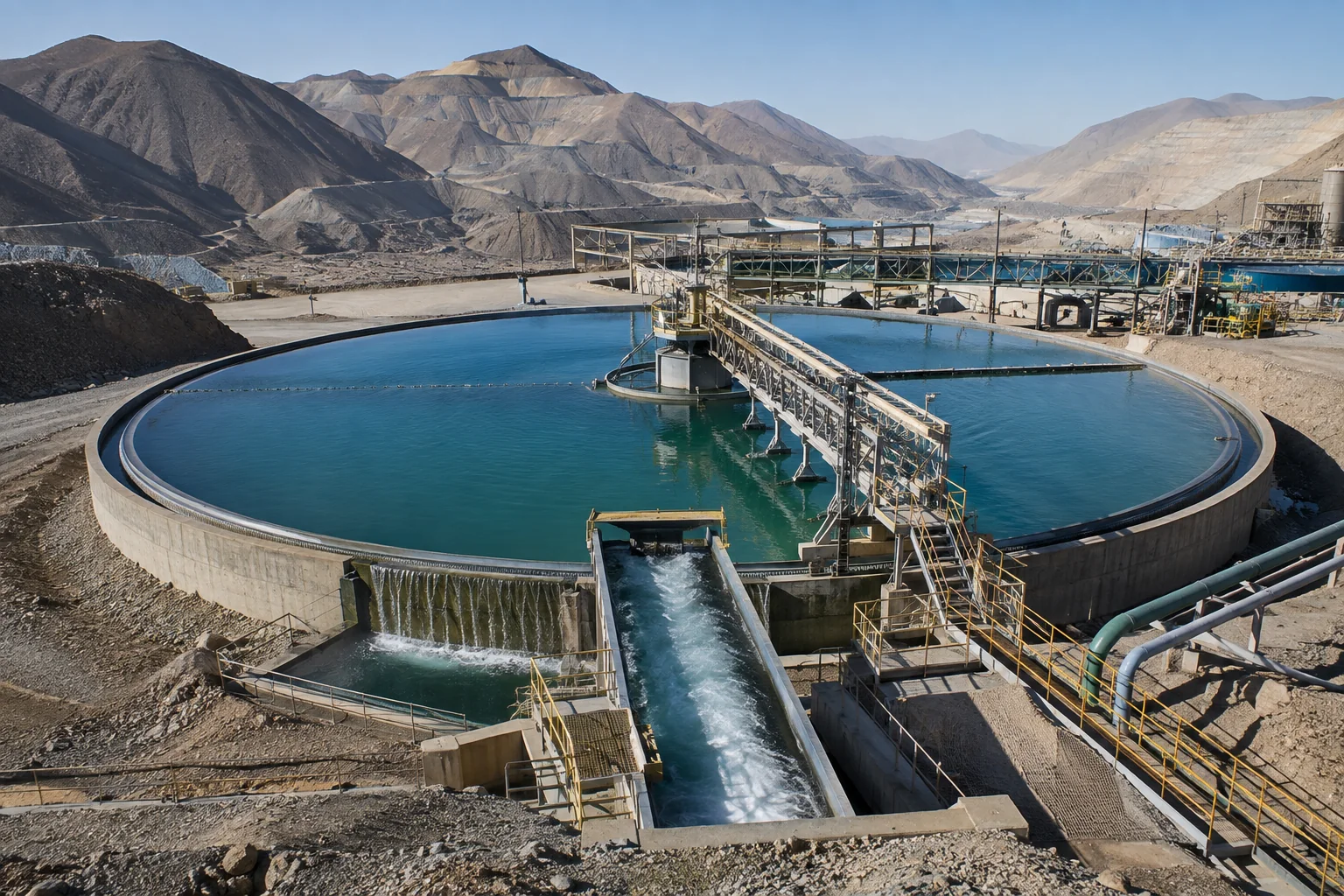
A coal-washing flocculant order should identify the exact separation duty. Clarifying wash water, thickening fine tailings and conditioning a dewatering feed can impose different requirements; an APAM that succeeds at one stage should not automatically be purchased for all three.
Name the feed and the duty
Record coal source or blend, ash-bearing fines, particle-size distribution, solids, pH, conductivity and upstream reagents. Include difficult clay-rich periods rather than relying on an unusually easy sample.
State whether the trial concerns a thickener, clarifier, filter or another separator. Provide the actual polymer addition point and residence. A general label such as coal plant water is too broad to define a reliable sample set.
Protect the water-recovery decision
Screen a dose curve on homogenized representative feed using controlled stock preparation. Record interface movement, overflow solids or turbidity and settled volume. Keep an existing-product control.
At plant scale, add solids throughput, bed condition, underflow consistency and recycled-water availability. Increased settling speed is not a sufficient commercial result when the underflow becomes unmanageable or fines return to the washing circuit.
Check the dewatering stage separately
If the thickener feeds a press, belt or centrifuge, test that equipment's capture, water quality, cake and throughput. Its conditioning product may require a separate charge-family or molecular-profile comparison.
Do not assume that more anionic polymer will correct biological or organic sludge behavior. The charge-family comparison explains why solids character must guide the first screen. Keep any second-stage chemical cost separate.
Translate trials into an order quantity
Use calibrated as-supplied consumption and the expected solids load to estimate demand. Include variability, preparation capacity, dry storage and delivery reliability rather than relying on nominal water flow alone.
Agree a trial quantity long enough to observe the separator through a defensible operating period. Protect a rollback stock and record how plant changes will be approved. A free sample without enough material for repeatable testing cannot settle a bulk-supply decision.
Specify the release record
Keep approved code, batch, feed envelope, preparation standard, dose band and endpoints with the purchase order. Require notification of material substitutions or changes to the supplied specification.
Send the process and demand record through the coal-washing APAM request. Ask for proposed codes and reasons for their inclusion. Final supply should follow the accepted application result, not a promise that one mining grade covers every coal stream.