
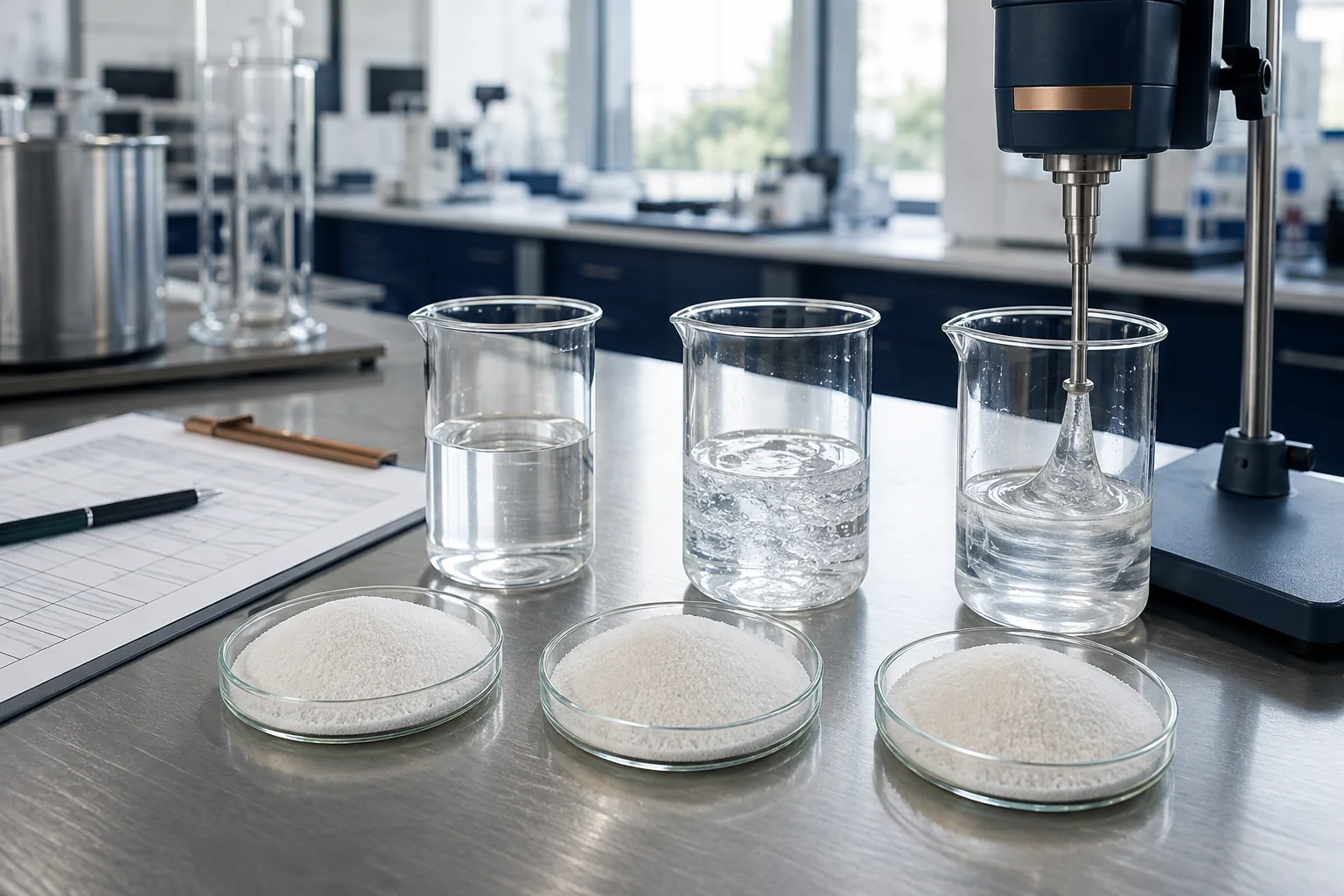
A low anionic polyacrylamide price per tonne is useful only when the purchased grade produces an acceptable separation result. For a mineral circuit, normalize offers to the same dry-solids throughput and operating target before discussing a saving.
Put every quotation on the same basis
Ask for the exact product code, commercial form, declared active basis, order quantity, currency, delivery term, named destination and quotation validity. Freight, taxes and unloading responsibilities can make apparently similar prices cover different scopes. Keep optional services separate from the material price.
Do not treat dry matter, nonvolatile content and active polymer as automatically identical. Ask how the supplier defines the quoted property. A powder-versus-emulsion comparison needs both the accepted product consumption and the different preparation requirements.
Calculate chemical cost without double correction
If a trial reports active polymer in grams per tonne of dry solids, commercial consumption in kilograms per dry-solids tonne equals active dose divided by 1,000 and by the declared active mass fraction. Multiply that consumption by delivered price per commercial kilogram.
If the trial already records as-supplied grams per tonne, divide by 1,000 only. Applying the active fraction again exaggerates consumption. Keep the original weighing record and solids measurement with the calculation so purchasing and operations can reproduce the result.
Keep the accepted endpoint fixed
Compare candidates at equivalent overflow quality, solids throughput, underflow handling and downstream filtration. A lower dose that leaves fines in recovered water is not equivalent to a dose that meets the water target. A fast-settling product may also create a more difficult cake.
Use repeated runs rather than selecting the cheapest single jar. The active-dose and jar-test method provides the calculation framework; the commercial comparison should use its accepted operating band, not an isolated minimum.
Add costs that change with the grade
Record make-down water, usable stock output, operator time, cleaning, cake haulage and any production constraint. Include only measured differences attributable to the comparison. Avoid assigning speculative savings to water recovery or throughput that the plant trial did not establish.
Keep normal and difficult feed periods separate. An offer can be economical in one ore campaign and unsuitable in another. Where the difference is smaller than measurement uncertainty, consistency and supply execution may matter more than the apparent decimal saving.
Request a comparable commercial offer
Send delivered quantity, destination, measured consumption, accepted endpoint and preparation conditions with the APAM quotation brief. Ask suppliers to identify exclusions and proposed alternatives rather than silently replacing the qualified grade.
Approve price and technical identity together. Record the product code, calculation basis, lot checks and validity period so a repeat order remains comparable when freight, feed solids or supplier specifications change.